A Film Casino Is Built for the Frame
Learn how to read a film casino through camera position, lighting, and editing, and see how those choices turn a fictional venue into story.
How can you tell what a film casino is doing for the story, rather than how a real casino works? Watch the camera, the light, and the cuts: a film casino is built for the frame, and its layout often serves the scene before it serves any practical use.
Try a week-long viewing routine with one film or a few scenes. The aim is not to judge whether a set looks authentic. It is to notice how the venue steers your attention, defines relationships, and changes the mood as the story moves.
Begin with the camera’s position
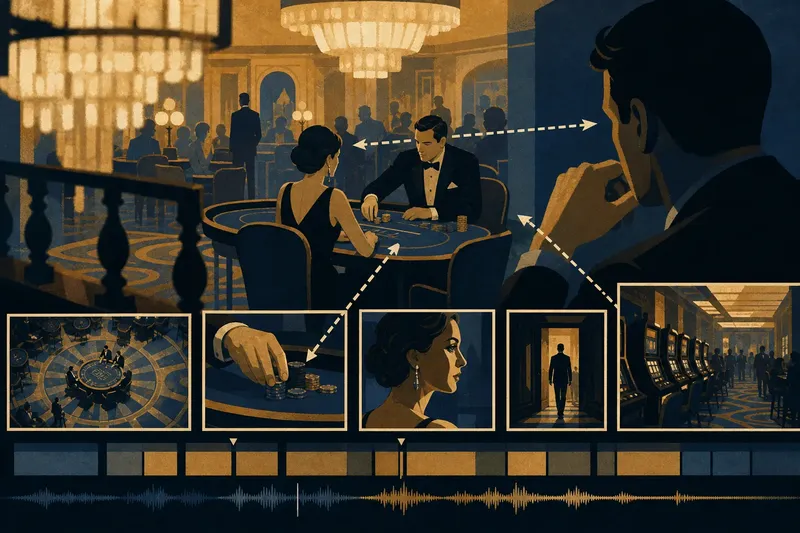
On the first viewing, follow where the camera stands and what it can see. A high, wide view may make a character seem exposed within a patterned floor, while an eye-level shot across a table can make the space feel like a private contest. The camera’s position is a storytelling choice, not a neutral tour of the room.
Notice what blocks the view. A foreground chandelier, a row of chairs, a doorway, or the edge of a gaming table can divide the image into layers. If a character is partly hidden, ask whether the scene is creating uncertainty, emphasizing surveillance, or simply guiding your eye toward someone else.
Also note what the frame leaves out. A tight shot on a hand and a face can make a large room feel irrelevant; a wide shot may make the same characters appear small against the venue. The location’s apparent scale is therefore partly an effect of framing.
Track how lighting assigns attention
On the next viewing, look for the brightest and darkest parts of each shot. Light can isolate a face from a busy background, turn a doorway into a point of suspense, or let reflective surfaces make the room seem restless. These effects help organize the image even when the set is crowded with decorative detail.
Separate the light that appears to come from the venue from the light that shapes the scene for the camera. A practical lamp or glowing sign may give the audience a plausible source; a soft highlight on an actor’s face may make an expression readable. The two can coexist without matching the illumination a visitor would experience in a real room.
Color matters as much as brightness. Warm amber can make a corner feel intimate or old-fashioned, while cool blue can distance a character or sharpen a sense of unease. Neither color carries one fixed meaning: compare it with the performances, the music, and what has just happened.
Use the week to watch one element at a time
A short routine prevents the venue’s many details from becoming visual noise. Rewatch the same scene on separate days, or choose a different scene each day that uses a casino setting. Keep a few notes in a paper notebook or a simple document; a timestamp and one observation are enough.
- Day one: map the frame. Note whether the camera is wide, close, high, low, or level with the characters. Add what the frame excludes.
- Day two: follow attention. Record what your eye reaches first: a face, a hand, a light source, a doorway, or a piece of décor.
- Day three: watch the light. Mark where the strongest contrast falls and whether it changes between shots.
- Day four: study movement. Follow a character or camera move through the space. Ask whether the movement reveals a relationship, creates tension, or simply changes the composition.
- Day five: listen to the cut. Note when a shot ends, what appears next, and whether sound continues across the edit.
- Day six: compare two moments. Look for a repeated angle, color, object, or sound and consider whether its meaning has shifted.
- Day seven: write the scene’s purpose. In one sentence, say what the venue helps the audience understand about the story at that point.
If a day gets missed, continue with the next observation rather than turning the routine into a catch-up project. The useful habit is focused attention, not a complete catalogue of every prop.
Read editing as a change in emphasis
Editing shapes the casino as much as the set does. A cut from a sweeping view to a close-up may move attention from spectacle to a character’s decision. A sequence of brief shots can make the room feel unstable or fast-moving, while a longer take gives the audience time to watch bodies and sightlines share the same space.
Pay attention to what connects one shot to the next. The edit may follow a glance, a sound, or a hand reaching toward an object. It may instead create a contrast, cutting from bright public activity to a quiet face. That contrast can reveal more about the story than the venue’s decorative style.
Sound can make a cut feel continuous even when the images change sharply. Music, crowd murmur, or a distinct mechanical sound may carry over a new angle and bind separate views into one dramatic moment. Ask whether the sound makes the room seem lively, oppressive, distant, or strangely empty.
Ask what the casino contributes to the scene?
Why does the camera avoid showing the whole room?
A partial view can preserve uncertainty or make a character’s immediate problem feel more important than the setting. It can also keep the audience aligned with someone who does not yet understand the space.
Does bright lighting mean the scene is cheerful?
Not necessarily. Brightness can expose a character, make the room feel artificial, or heighten the contrast with private tension. Read the light alongside expression, blocking, and sound.
What does a cut to a close-up usually change?
It often shifts emphasis from the casino’s spectacle to a particular reaction or choice. Check what prompted the cut and what the next shot asks you to notice.
How can a fictional casino feel larger than its set?
Wide framing, layered reflections, repeated sightlines, and sound that suggests activity beyond the image can imply a broader venue. The film needs to establish the impression, not show every corridor or table.
Separate the story’s room from a working venue
A film set may combine visual references without reproducing a real floor plan. A doorway may be placed for a clean entrance, a table turned to face the camera, or a corridor arranged to make a character seem watched. Treat these as clues to staging, not as evidence about how an operating venue is organized.
This distinction is especially useful when a scene makes movement look effortless. Editing can compress a journey, hide a pause, or connect spaces that would be farther apart in an actual building. The screen offers a designed path through the room, not necessarily a reliable map.
It is not worth trying to identify every fixture or infer a precise floor plan from a few shots. Unless the story makes a particular object important, inventorying décor can distract from the stronger question: why does the scene want you to look here now?
Turn observations into a short scene reading
Imagine you revisit a fictional casino scene in which a character enters under a warm, crowded wide shot. The camera then cuts to a cool close-up as the character spots someone across the room, while the crowd sound continues. You could note that the wide shot establishes social exposure, the cooler close-up narrows attention to recognition, and the carried sound keeps the public setting present even as the story turns personal.
That reading stays close to observable choices without claiming what a real casino would look or sound like. If another interpretation fits the scene better, refine the note by pointing to a specific frame, cut, or sound cue. The goal is a defensible reading, not a single correct answer.
For a compact film casino analysis, name the camera position, identify the light or contrast that directs attention, and describe the edit that changes the scene’s emphasis. Then connect those choices to what the story asks the audience to feel or understand. A film casino is easiest to read when you treat the room as part of the scene’s language, not as a venue waiting to be documented.