Roulette’s Layout, Read from the Outside In
Understand the roulette layout by reading its labels and positions, so you can tell where each wager belongs without mistaking the design for a prediction.
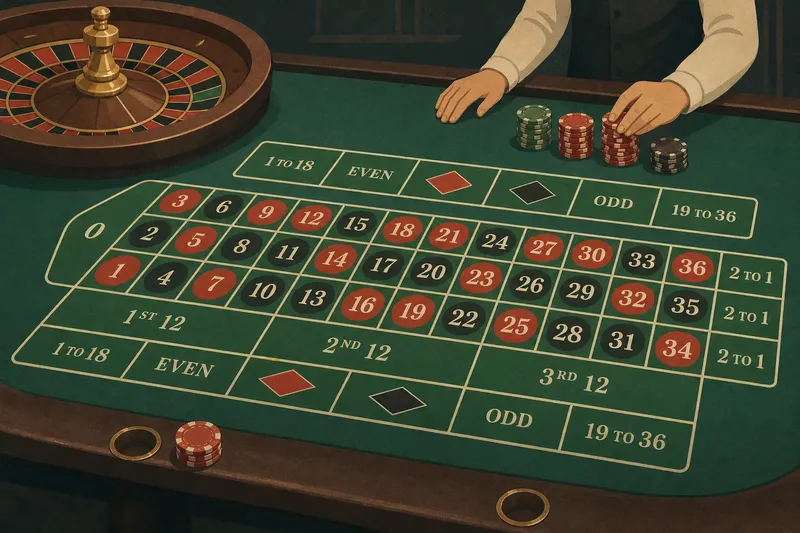
Where should your eyes go first if a roulette layout looks like a crowded grid of numbers and labels? Read the roulette layout from the outside in: begin with the broad labels around the numbered field, then move toward the individual numbers. This makes the table’s visual grammar easier to follow without suggesting that any position predicts what will happen next.
Start with the numbered field and its surrounding choices
The central part of a roulette layout is a numbered grid, usually arranged in three horizontal rows. A printed layout may place a single zero or a double-zero space alongside those rows; the exact arrangement depends on the game offered. The numbers are not set out in the same sequence as the wheel pockets, so the grid is best read as a map for placing wagers, not as a picture of the wheel.
Outside the number grid, larger spaces carry labels for groups of outcomes. These are often called outside bets because their printed areas sit beyond the individual number spaces. The name describes location on the layout, not a physical boundary that has special predictive meaning.
If you are simply trying to follow a display or understand a scene in a film, this outer band is a useful starting point. Its broad labels make the table’s categories visible before the smaller details come into view.
Read the outer band by label and position
On many layouts, labels identify color, parity, and broad ranges of numbers. “Red” and “Black” refer to the printed color categories; “Odd” and “Even” divide numbered outcomes by parity; low and high labels distinguish lower and upper number groups. Zero spaces are generally outside those ordinary groupings, so their placement and treatment matter when reading the printed design.
Another set of labels names dozens and columns. A dozen groups numbers into one of three blocks, while a column groups the numbers that occupy the same vertical track in the grid. These categories overlap: one number can belong to a color group, a parity group, a dozen, and a column at the same time.
Say you are looking at a layout and want to understand the label “2nd 12.” You would read it as the middle block of twelve numbered outcomes, then locate that label in the outer band; you would not infer that the block is more likely because it occupies a prominent position. The expected result is a clearer reading of the category and where it is printed, not a forecast.
Choose the reading path that fits your situation
- If you are watching a game from a distance, begin with the large outside labels. They are easier to distinguish than small numbered spaces and show which broad categories the layout offers.
- If you are learning the vocabulary, compare one label at a time with the numbered grid. For instance, follow a column label inward to see the vertical group it names.
- If you are studying a photograph or screen, use the printed divisions rather than chip colors or hand gestures as your guide. A cropped image can hide context, so identify the visible labels before interpreting a placement.
- If you are following a particular number, look for its own square in the grid, then note the larger groups it also belongs to. This separates the number’s location from the overlapping labels around it.
- If you are comparing layouts, check first whether the printed field includes one zero or two and how its outside labels are arranged. Those visible details can change the layout’s appearance and category boundaries.
For a casual viewer, the first two approaches are usually enough: broad labels explain the layout’s main visual structure, and the grid clarifies individual positions. Memorizing every possible grouping is not worth the effort unless you have a specific reason to read the table closely.
Follow the inner field to distinguish spaces
Once the outer band makes sense, move inward to the numbered squares. Each square represents an individual number, while the lines between squares help show where one printed space ends and another begins. In a busy image, those borders may be faint; the number itself and its alignment with the grid are more useful than a chip’s apparent proximity.
Adjacent numbers on the printed grid are not necessarily neighboring pockets on the roulette wheel. The table and wheel organize information for different purposes: the layout groups choices into readable spaces, while the wheel displays the physical sequence of pockets. Keeping those two arrangements separate prevents a visual pattern on the felt from being mistaken for a pattern in outcomes.
Zero deserves a deliberate glance. Depending on the layout, it may sit in a space distinct from the three numbered rows, and it may not fit the red/black, odd/even, or low/high labels in the same way as numbered outcomes. Read the printed boundary and label rather than assuming every outside group includes every space.
Why does roulette’s layout look like a grid?
Why are the numbers not arranged in wheel order?
The grid is designed to make categories and individual spaces readable together, while the wheel presents pockets around a circular track. Their different shapes serve different visual jobs, so a grid sequence should not be treated as a wheel sequence.
What does an outside label cover?
An outside label names a group, such as a color, parity, range, dozen, or column. Its exact boundary is determined by the printed layout, especially where zero spaces are concerned.
Does a crowded area mean a number is favored?
No. A tight cluster of labels or chips reflects the table’s design and activity, not a signal about a future result. Read crowding as a visual feature, not as evidence.
How should I read a layout in a small image?
Look for the largest labels and the strong grid lines first, then identify which details remain visible. If the image cuts off a zero space or a group label, avoid guessing what the missing portion contains.
Use the printed design without turning it into a forecast
A roulette layout can show where categories sit, how they overlap, and which number each square names. It cannot make a printed position into a prediction tool. The useful distinction is simple: labels explain the organization of choices, while the game’s next outcome is not revealed by the layout’s visual grammar.
When you encounter a roulette layout in Tam Điệp or in a casino-style scene, begin at the outside band, trace a label inward, and check the numbered field and zero spaces before interpreting what you see. That outside-in reading makes the design legible while keeping description separate from prediction.